Google documents the UGC Fresh Data Program, a fast lane for forum and social content
Google has published documentation for the UGC Fresh Data Program, an application-only pipeline that lets large forum and social platforms send new posts and engagement data straight to Google.

The short version
- On 8 October Google documented the UGC Fresh Data Program, a dedicated ingestion pipeline for user-generated content.
- It's separate from the Indexing API and normal crawling. It's application only, and Google says it replies within 6 to 8 weeks.
- Platforms need high UGC volume, public content tied to public creator profiles, OAuth 2.0, strictly validated JSON-LD and active moderation.
- Acceptance doesn't guarantee anything appears in Search. For most sites nothing changes, but it shows how much Google values fresh discussion content.
Google added a new page to Search Central on 8 October: About the UGC Fresh Data Program. It describes a way for approved platforms to send fresh user-generated content, and the engagement signals that go with it, to Google through a dedicated ingestion pipeline.
It's separate from the Indexing API and from normal web crawling. It's also not something you can switch on. Platforms have to apply.
How it works
Platforms apply through a form. Google says it will respond "within 6-8 weeks", and accepted platforms get integration documentation and onboarding.
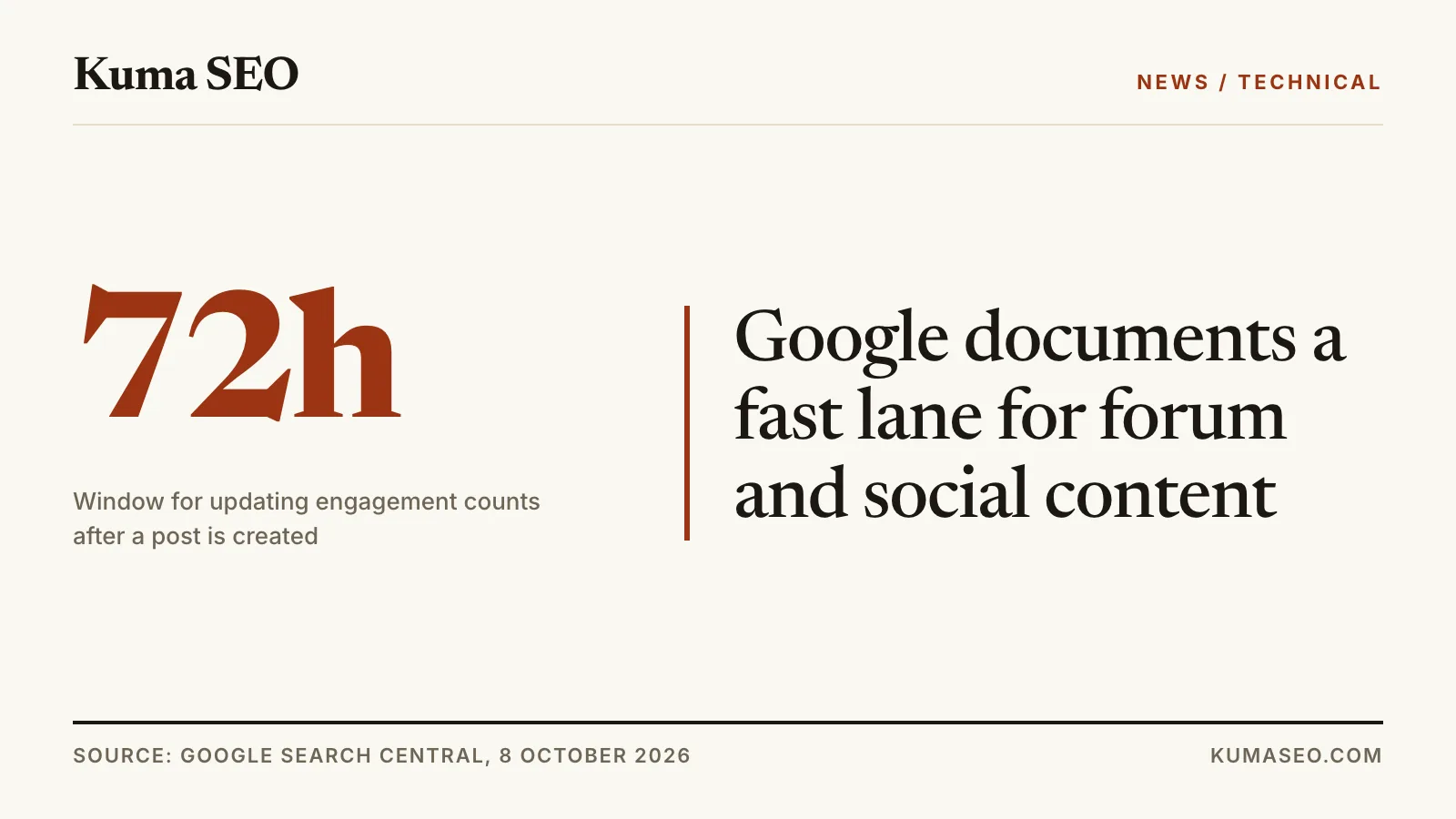
Once in, content should be sent as close to creation as possible, "ideally sent within minutes". Engagement counters, the interaction counts attached to each post, need updating regularly within 72 hours of the post being created.
Who is eligible
- The right kind of content. "The platform must primarily host UGC, social postings, or forum discussions," and that content has to sit on "dedicated pages with stable URLs, not on profile or feed pages."
- Scale. "A high volume of UGC content and a significant user base."
- Public content. Anything behind a login or paywall is ineligible, and each post must be attributable to a creator with a public profile.
- Technical ability. Platforms must be able to handle "secure OAuth 2.0 API authentication" and "strictly validated JSON-LD payloads", backed by valid on-page markup such as SocialMediaPosting or DiscussionForumPosting with interactionStatistic.
- Moderation. "Active content moderation, including a user reporting mechanism."
Google is clear that neither applying nor being accepted guarantees anything. In its words, the program "doesn't guarantee that content will appear in Search."
What it tells us
Most sites will never qualify, and that's fine. The interesting part is what the program says about Google's priorities. Fresh discussion content is valuable enough that Google built a separate pipe for it rather than waiting for its crawler to come round. If you've ever wondered how a forum thread posted an hour ago can already be in the results, this is one way it can happen.
Google hasn't said which platforms are in the program. We'd be wary of any list that claims to know.
It also fits a pattern in Google's recent documentation. On 24 September Google added a creator property to VideoObject structured data and clarified the supported interactionStatistic types. Who made a piece of content, and how people engaged with it, keep coming up.
What to do
- If you run a large community platform: read the eligibility list against your setup. Stable thread URLs, public profiles, valid markup and a working moderation queue are worth having whether you apply or not.
- If you run a smaller forum or a busy comments section: you probably won't qualify, but the same markup helps Google understand discussion pages through normal crawling. Google's discussion forum structured data documentation covers DiscussionForumPosting in detail.
- Everyone else: nothing to do. Keep your own crawl and indexing basics in order, and use our internal linking guide to make sure new pages get found quickly.
Sources
Filed underuser generated contentstructured dataindexing