Google's AI content guidance now points straight at the rater guidelines
Google updated its guidance on using generative AI content on 1 October. The policy hasn't changed, but the page now spells out how quality raters are told to judge scaled, low-effort content.

The short version
- Google updated its guidance page on generative AI content on 1 October to include material from the Search Quality Rater Guidelines.
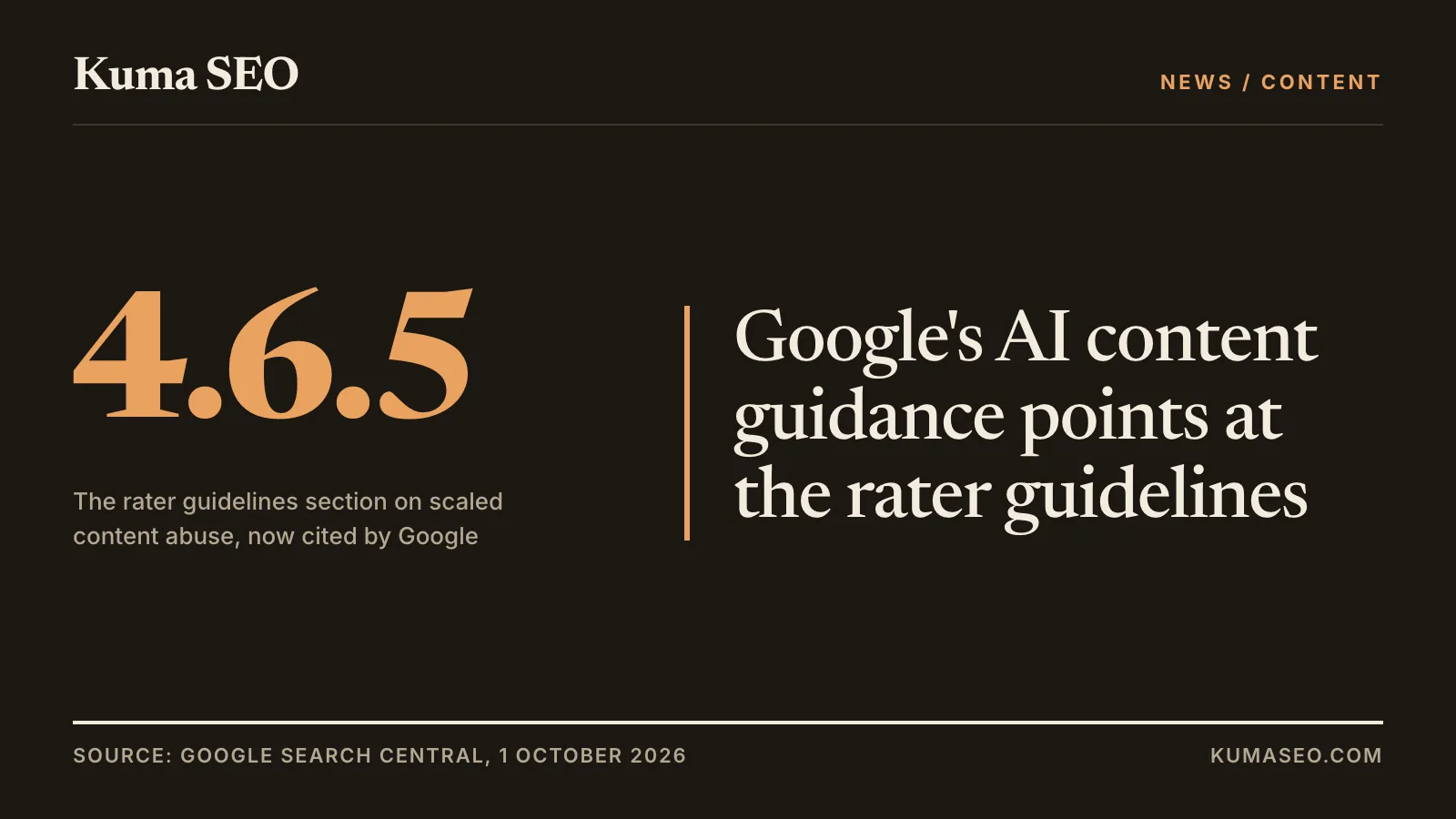
- It now points to two rater sections: scaled content abuse (4.6.5) and main content made with little effort, originality or added value (4.6.6).
- Google repeats that rater scores "don't directly influence ranking". The underlying spam policy hasn't changed.
- The page also says AI output needs checking for accuracy before it goes live, including metadata and structured data.
On 1 October Google updated its guidance on using generative AI content on your website. The Search Central changelog describes the change as adding information from the Search Quality Rater Guidelines. The page now shows "Last updated 2026-10-01".
The policy itself hasn't moved. What's changed is that the page now connects the policy to the language Google gives its raters, and that language is more concrete than the policy.
What's new on the page
The page now references two sections of the rater guidelines. Raters are asked to evaluate "scaled content abuse (section 4.6.5)" and "main content created with little to no effort, little to no originality, and little to no added value (section 4.6.6)."
Google is careful to add that raters' "ratings don't directly influence ranking." Raters help Google check whether its systems are working. They don't push individual sites up or down.
The policy line is the same one Google has held for a while: "using generative AI tools or other similar tools to generate many pages without adding value for users may violate" its scaled content abuse policy.
The rest of the guidance
The page also covers points that are easy to skip past:
- AI output needs fact-checking before it's published, and that includes metadata and structured data, not just the text people read.
- Structured data still has to follow Google's general guidelines and pass validation.
- Telling readers how content was made, for example by describing the automation involved, can give them useful context.
- Ecommerce sites have extra requirements, including IPTC metadata on AI-generated images and labelling AI-generated product data.
Our take
Notice what the test is. It isn't "was AI used". It's whether the page adds anything. Google's scaled content abuse policy applies however the content is produced, and the rater sections describe the pattern well: lots of pages, each a reworded version of what already ranks, with nothing original in them. That's a problem whether a person or a model wrote them.
Pointing at sections 4.6.5 and 4.6.6 is useful, because the rater guidelines are the most detailed description Google publishes of what low effort actually looks like. If you're making the case internally for slowing down a content programme, those two sections are better evidence than any blog post, including this one.
The fact-checking line deserves more attention than it gets. Title tags, meta descriptions and schema are where AI mistakes hide, because nobody reads them closely. A wrong price in Product markup or a made-up date in an Article schema is still a wrong fact.
A quick self-check
- If you deleted the page, would anything be lost that isn't already on the first page of Google? If not, it's exposed.
- Does it include anything a model couldn't have produced without you: your data, your photos, your test results, your opinion?
- Has a person checked every number, name and date, including in the title tag, meta description and structured data?
- If you publish at scale, could you explain your process to a Google reviewer without wincing?
The September spam update, which ran from 24 September to 8 October, didn't name a target, but scaled content is one of the policies it could have touched. Our spam update write-up covers how to check. For planning content that adds something, start with our keyword research guide.
Sources
Filed underai contentscaled content abusequality rater guidelines