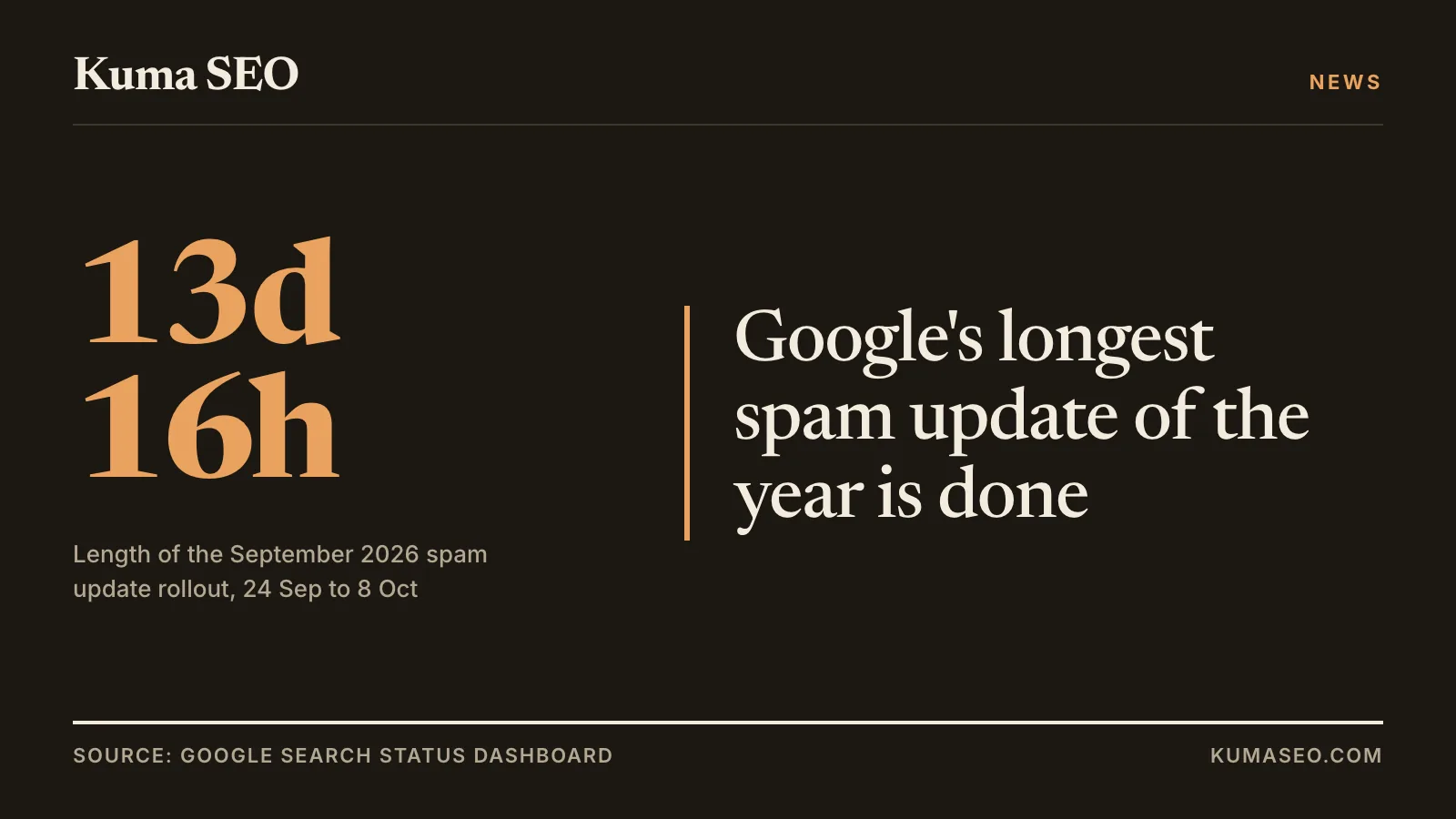
Rankings crashed in late September? Check your rank tracker before you panic
Morningscore says Google served its rank tracker truncated result pages for about a week from 24 September, the same day the spam update started. Sites missing from those pages looked like they had lost rankings.

On this page
The short version
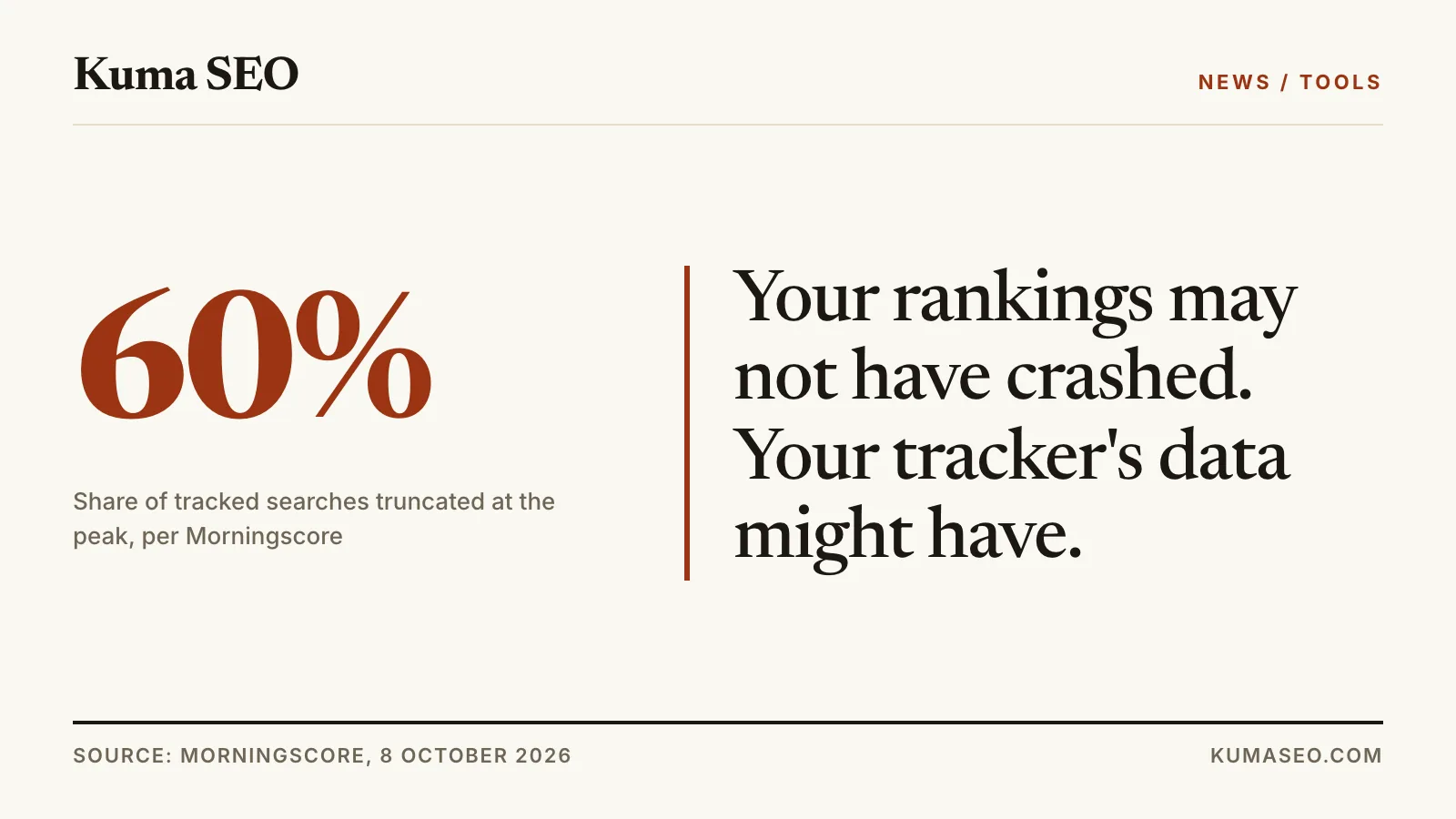
- Morningscore says Google returned cut-down result pages to its tracker from 22:10 UTC on 24 September, peaking at about 60% of searches on 30 September and 1 October.
- On those pages, an average of 7.9 of the previous top 10 sites were missing. Normal browser searches showed full results at the same time.
- By 4 October truncation was down to 1 to 2% of searches. Google hasn't commented, and this is one vendor's data.
- Because it overlaps the September spam update, check any late September drop in Search Console before acting on it.
If your rank tracker showed a cliff edge in the last week of September, it might not be your rankings. Morningscore, an SEO tool with its own rank tracker, has published a detailed write-up saying Google sent its tracker truncated search results for about a week, starting on 24 September.
The post is by co-founder and CEO Karsten Madsen. It was published on 8 October and updated on 14 October.
What Morningscore saw
Morningscore loads several pages of Google results per keyword to build a top 50. From 22:10 UTC on 24 September, many of those searches came back with fewer than 40 results instead of around 50. Its figures, from more than 4 million searches:
- At the peak, on 30 September and 1 October, about 60% of searches came back truncated. Before 24 September the usual rate was 1.2% to 1.5%.
- In truncated results, an average of 7.9 of the previous top 10 sites were missing, sometimes including the number one result.
- Keywords dropping from the top 20 to "not ranking" jumped from about 51 every 30 minutes to about 444 every 30 minutes between 25 and 29 September.
- 74% of the sites that vanished were back in the top 20 within three days, and 92% came back eventually. In a normal period, about 6 in 10 come back within three days.
- By 4 October, truncation was down to about 1% to 2% of searches.
A normal browser search showed full results throughout.
What caused it
Morningscore thinks Google started treating automated searches differently, rather than changing rankings. Its evidence is that real browsers saw full results, and that its data providers received truncated pages at very different rates.
It's also clear about what it can't prove. Google hasn't explained anything, and Morningscore can't confirm the cause from outside. The company is candid about its own part as well: it recorded the truncated pages as real drops for days, says its monitoring should have caught the problem sooner, and apologises for it.
There's a precedent. In September 2025, Google stopped supporting the &num=100 parameter that many trackers used to pull 100 results in one request, and ranking data shifted across the industry. Trackers depend on Google behaving the same way for bots as it does for people, and Google has no obligation to do that.
Why the timing matters
Google's September 2026 spam update also started on 24 September, and Search Engine Roundtable logged volatility on 25 to 27 September and 30 September. Some of what looked like spam update movement in third-party tools may have been broken data. Some of it may have been real. A tracker chart on its own can't tell you which.
This is one vendor's report. We don't know how many other tools were affected, and if yours showed nothing odd, it may simply fetch results in a different way.
How to check your own data
- Open your rank history for 24 September to 2 October. Drops to "not ranking" that reversed within a day or two are the pattern Morningscore describes.
- Look at the drops together. Lots of keywords falling on the same day and then bouncing back points to a data problem, not a ranking one.
- Check the same keywords in Search Console. Clicks and average position there come from real searches. If Search Console is flat, don't touch the page.
- Treat anything that persists as real. If a drop is still showing in Search Console after the spam update finished on 8 October, investigate it properly.
Our take
Rank trackers are useful for spotting movement across hundreds of keywords at once. They're a poor source of truth on their own, and this is a good reminder why. Put tracker data next to Search Console before you report a drop to a client or rewrite a page. If you're choosing a toolset, our Ahrefs vs Semrush comparison covers how the two big suites handle tracking.
Sources
Filed underrank trackingseo toolsspam update